

Understanding emissions across Kirklees
Mon, 12/01/2025 - 15:45
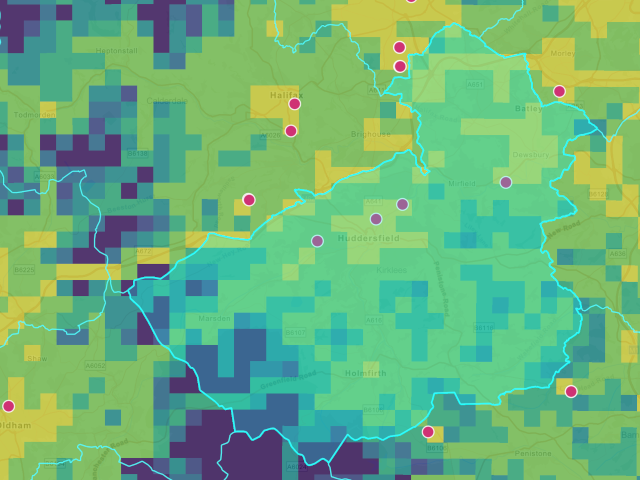
Kirklees Climate Commission has created a new working group to better understand the sources of greenhouse gas emissions across the district.
The group is led by Richard Clifton, who joined the Commission in early 2025 and brings extensive industrial experience in carbon monitoring and emissions reduction. He is now working with other Commissioners with relevant expertise, including Professor Peter Roberts, Gideon Richards and Dr Jialan (Snow) Wu , to review what data is available for the region, and how that can be used strategically to help reduce emissions.
"An initial trawl through UK government websites showed that there is a huge amount of data available - ranging from high level statistics for the authority as a whole, to detailed analysis for gas and electricity down to relatively small groupings of meters," Clifton says.
The group has shown how the available data can be used to track historical changes in carbon dioxide emissions. The data clearly shows the change from coal to natural gas for electricity generation, and how emissions were linked to economic activity within the Kirklees district.
However, the group soon realised that more detailed analysis will be needed to identify the biggest opportunities to reduce emissions from different parts of the district. The data which is available is generally not in a form that can be easily viewed or analysed.
The Kirklees group is now talking to the West Yorkshire Combined Authority and other regional organisations to see if they are already working on making the data more accessible and useful. If not, the group will develop their own models to allow emissions data to be more easily analysed. That will then help the Commission to work with local communities and businesses to help them improve their energy efficiency and reduce pollution.
The group is also looking to develop simple but powerful tools which will allow individuals and small businesses in Kirklees to understand and reduce their emissions. Anonymised information from households and SMEs could also help improve the modelling of energy consumption and emissions across the district.